Over the past several years, cloud adoption has accelerated across public safety technology.
Computer Aided Dispatch (CAD), Records Management Systems (RMS), analytics platforms, and other mission-critical workloads are increasingly being delivered through cloud infrastructure.
In almost every conversation about security in these environments, three frameworks appear: CJIS, SOC, and NIST.
These frameworks are essential. They provide a strong foundation for protecting sensitive public safety information.
But there is an important reality that is often overlooked.
None of these frameworks were designed to define operational performance for mission-critical public safety systems.
CJIS: Protecting Criminal Justice Information
The CJIS Security Policy exists to protect Criminal Justice Information, or CJI.
It establishes security requirements for systems that store, process, or transmit sensitive law enforcement data.
CJIS focuses primarily on data protection and access control.
Examples of CJIS security controls include:
- Strong identity management and access control
- Encryption for CJI in transit and at rest
- Personnel screening and security awareness requirements
These controls are critical for protecting sensitive law enforcement data.
But CJIS does not define expectations for how systems perform operationally.
CJIS does not establish service level agreements, recovery objectives, disaster recovery testing requirements, or uptime accountability.
A system can be fully CJIS compliant and still experience extended outages.
SOC Reports: Validating Security Controls
SOC reports provide independent verification that organizations have implemented and follow defined control processes.
SOC stands for System and Organization Controls, and these audits are conducted by independent third-party accounting firms.
SOC reports typically evaluate controls related to security, availability, processing integrity, confidentiality, and privacy.
Examples of SOC control validation include:
- Controlled change management practices
- Periodic access reviews
- Logging and monitoring of security events
SOC reports provide valuable third-party validation of these processes.
But they do not define operational expectations for mission-critical public safety systems.
A vendor can maintain a clean SOC report while still experiencing outages that impact emergency services.
SOC validates controls and processes, not operational performance.
NIST: Cybersecurity Frameworks and Best Practices
The National Institute of Standards and Technology, or NIST, provides widely adopted cybersecurity frameworks used across government and critical infrastructure.
The NIST Cybersecurity Framework and NIST 800-53 provide structured guidance for managing cybersecurity risk.
These frameworks help organizations design mature security programs across five major functions: Identify, Protect, Detect, Respond, and Recover.
Examples of NIST guidance include:
- Risk identification for critical systems and dependencies
- Incident response planning and escalation procedures
- Continuous monitoring and vulnerability scanning
NIST provides excellent cybersecurity guidance.
But like CJIS and SOC, NIST does not define operational performance expectations for public safety systems.
It does not establish uptime guarantees, recovery objectives, disaster recovery validation, or SLA transparency.
The Operational Gap in Public Safety Cloud Systems
When public safety systems move to the cloud, security frameworks alone are not enough.
Emergency services depend on technology that must remain available during severe weather, infrastructure failures, cyber incidents, and regional disasters.
Operational expectations become just as important as security controls.
This is where Public Safety Cloud Standards (PSCS) enter the conversation.
PSCS focuses on defining operational resilience for mission-critical public safety systems.
Examples of operational standards include:
- Clearly defined uptime expectations for critical systems
- Recovery Time Objectives that align to mission needs
- Recovery Point Objectives that define acceptable data loss
- Disaster recovery validation through testing and documented results
These expectations help ensure that cloud environments are designed to support the realities of emergency services.
The Complete Framework
Each of these frameworks serves a specific purpose.
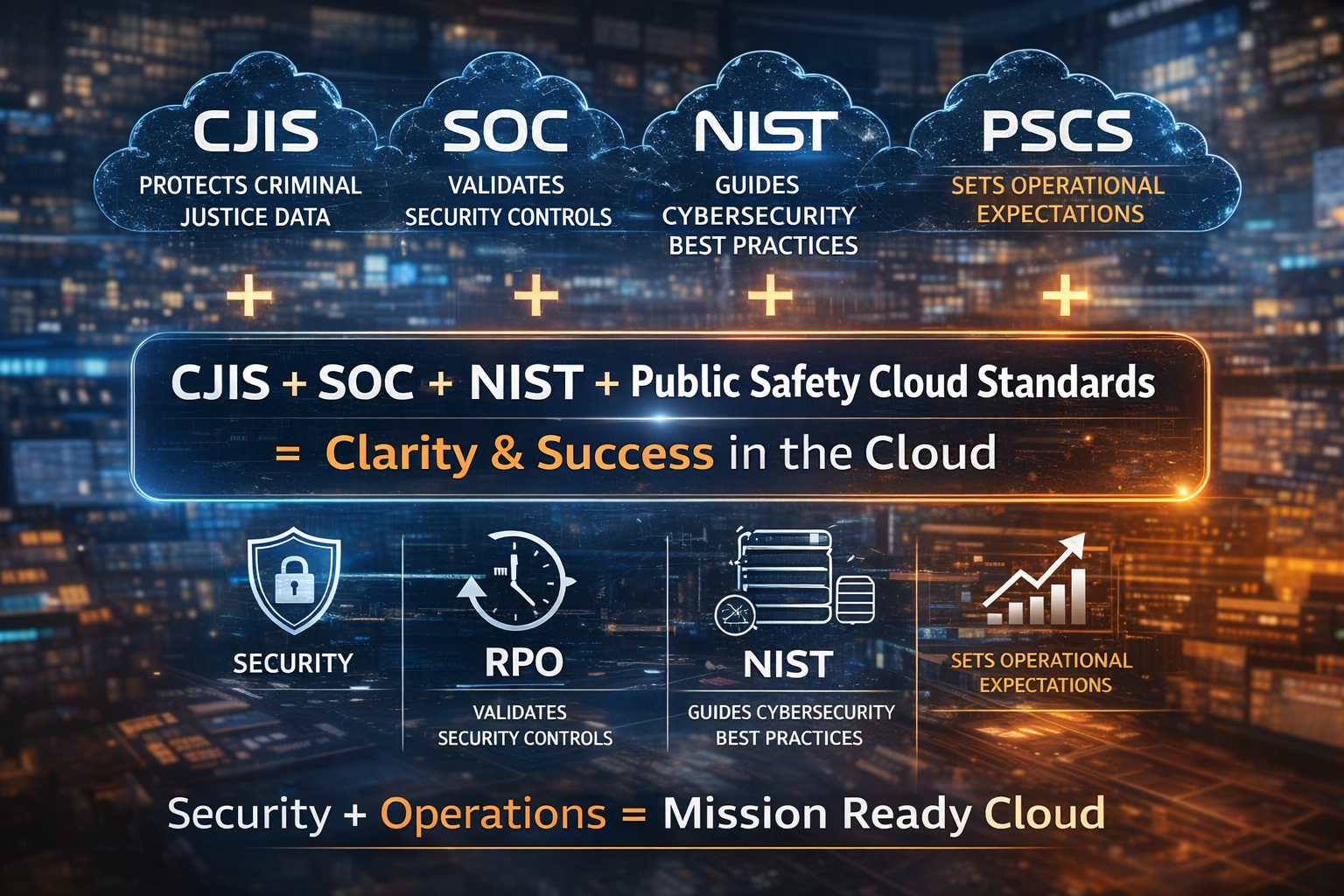
CJIS protects criminal justice information.
SOC validates that security controls are implemented and followed.
NIST provides cybersecurity frameworks and best practices.
But operational resilience requires an additional layer of standards.
When combined, these four components create a more complete foundation for public safety cloud environments: CJIS + SOC + NIST + Public Safety Cloud Standards.
Final Thought
As public safety agencies continue adopting cloud technologies, both security and operational resilience need to be part of the conversation. In emergency services, technology availability is not just a technical metric. It is a public safety responsibility.