Observability is one of those topics that sounds technical until something goes wrong. Then it becomes operational.
In public safety, agencies do not care about observability as a buzzword. They care about whether someone knows there is a problem, whether anyone is responding to it, whether the issue can be corrected quickly, and whether the agency is being kept informed while it is happening.
That is the real conversation.
As more CAD, RMS, JMS, mobile, and other mission-critical systems move into vendor-hosted cloud environments, observability becomes one of the most important operational capabilities behind the scenes. It is not just about dashboards, logs, and metrics. It is about trust, response, clarity, and continuity when agencies depend on systems that are no longer hosted in their own building.
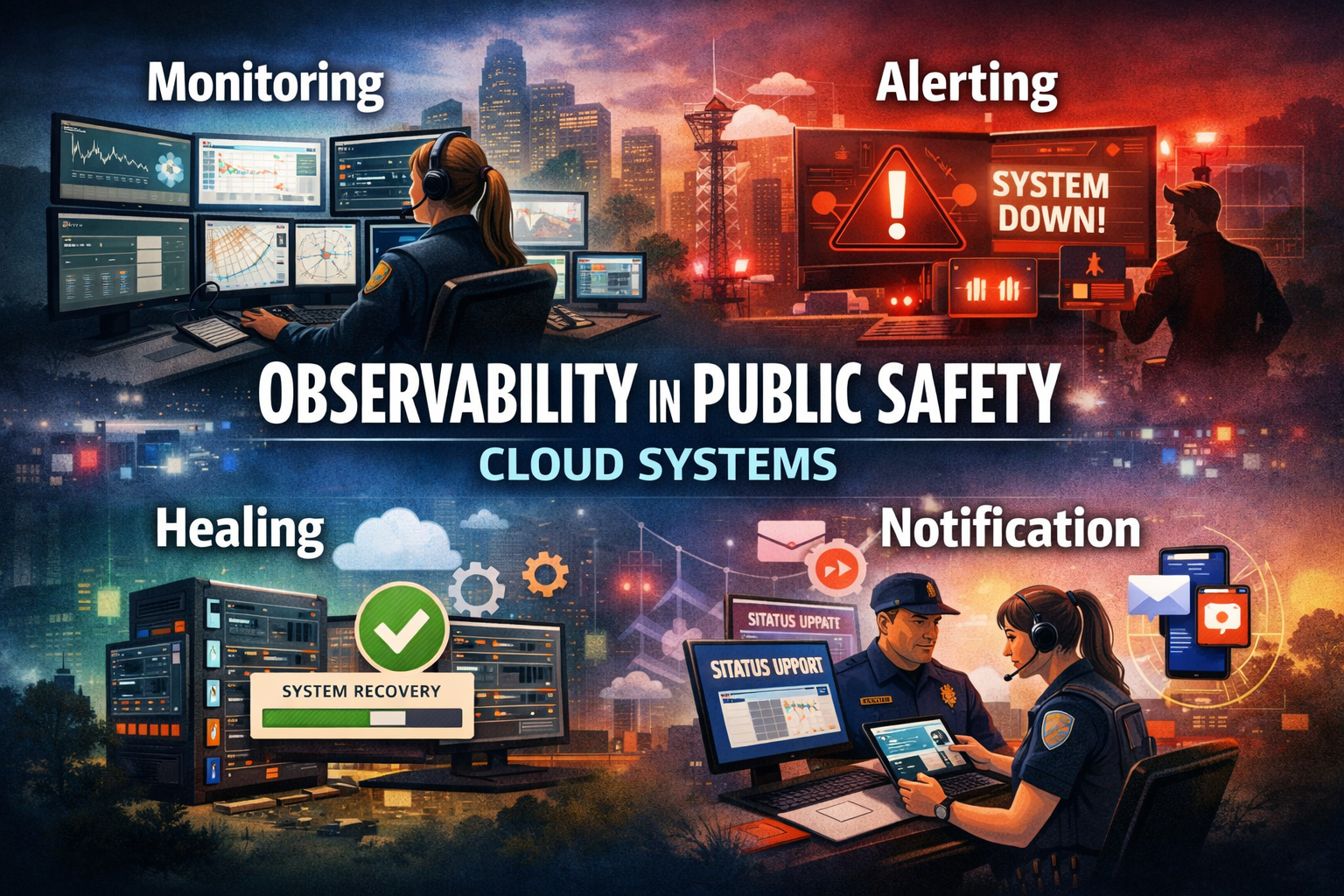
At a high level, agencies should think about observability in four parts: monitoring, alerting, healing, and notification.
1. Monitoring: Is the Vendor Watching the Right Things?
Monitoring is the foundation.
A vendor hosting mission-critical public safety software should be monitoring infrastructure, applications, integrations, network paths, database performance, storage, backup jobs, and service dependencies. That includes more than whether a server is “up.” It should also include whether the software is healthy, whether transactions are processing normally, whether interfaces are delayed, whether response times are degrading, and whether failures are beginning to cascade across the environment.
For public safety, monitoring should reflect how the system is actually used in the field. It is not enough to know that CPU usage is acceptable if dispatchers are experiencing delays, mapping is lagging, mobile units cannot retrieve data, or a downstream interface has stopped updating.
Agencies may never see the vendor’s internal monitoring tools, and that is fine. The point is not that the agency must operate the platform. The point is that the vendor should be monitoring the environment in a way that matches the operational reality of 24x7 public safety.
2. Alerting: When Something Breaks, Who Knows and How Fast?
Monitoring without alerting is incomplete.
If something goes wrong, the right people on the vendor side should know immediately. Alerts should not depend on a customer calling support first. In a mature cloud operation, the vendor should already know about major failures, service degradations, unhealthy nodes, failed backups, broken integrations, or abnormal application behavior.
This matters because in public safety, time lost in detection becomes time lost in response.
Alerting should be designed with severity in mind. Not every issue is equal. Some events are informational, some require engineer review, and some should trigger immediate operational response. Mature environments distinguish between noise and urgency, rather than flooding teams with meaningless alarms or missing the critical one.
From the agency perspective, the key issue is not the alerting platform itself. It is whether the vendor has a disciplined process behind it. Who gets paged? What triggers escalation? Is there 24x7 coverage? How quickly is an engineer involved? How is impact assessed?
A strong cloud provider should be able to explain not just that they have alerting, but how alerting turns into action.
3. Healing: What Happens After Detection?
Detection is only the beginning.
The next question is whether the environment can recover quickly, automatically, or at least in a controlled and repeatable way. In cloud operations, this is where healing comes in.
Healing can take many forms. It may mean restarting a failed service, replacing an unhealthy instance, failing over to another node, rerouting traffic, reprocessing a queue, or triggering an automated workflow that restores capacity without waiting for manual intervention. In more serious events, it may mean coordinated human response, deeper troubleshooting, and formal incident handling.
For public safety systems, healing should be designed with operational continuity in mind. If a single component fails, does the service keep running? If a server becomes unhealthy, is it automatically replaced? If performance drops, does the platform scale or rebalance? If an interface gets stuck, is there detection and response before it becomes an agency-discovered outage?
This is where architecture and operations come together. Observability should not just tell the vendor something is broken. It should support recovery.
Agencies should not assume that “hosted in the cloud” automatically means self-healing. Some environments are highly automated. Others are still dependent on manual response. That difference matters.
4. Notification: How and When Is the Agency Informed?
This is the part that agencies care about most, and the part that is often the least clear.
Even if the vendor is monitoring well, alerting internally, and taking corrective action, the agency still needs clarity. If there is an outage, slowdown, degradation, or service interruption, how does the agency find out? Who is notified? How fast? Through what method? With how much detail?
Agencies should not be left wondering whether they are seeing a local issue, a user issue, a known vendor issue, or a broader service event. They should not have to open a ticket just to learn whether the vendor is already working on it.
Notification is where observability becomes customer communication.
For public safety systems, agencies should know:
- whether they will be proactively notified of outages or degradations
- what thresholds trigger communication
- whether they will receive updates during the event
- whether they will be told when service is restored
- whether there will be a post-incident explanation afterward
- how planned maintenance communication differs from unplanned incidents
This does not mean the agency needs every internal technical detail. It means the agency needs enough timely information to make operational decisions, communicate internally, and maintain trust in the service.
In public safety, silence during an incident creates its own risk.
Observability Is Not Just Technical Maturity. It Is Operational Maturity.
Too often, observability gets framed as a technology stack: logs, dashboards, metrics, traces, alerts. Those things matter, but for agencies, that is not the real point.
The real point is whether the vendor is operating the system in a way that reflects the seriousness of public safety. Can they detect issues quickly? Can they distinguish technical noise from operational impact? Can they respond effectively? Can the platform recover in a controlled way? Can they keep the agency informed?
That is what good observability should deliver.
For agencies evaluating a cloud-hosted public safety provider, observability should be part of the conversation from the start. Not as a technical side topic, but as a core operational expectation.
Final Takeaway
When a system is supporting dispatch, records, field response, detention, or other mission-critical work, observability is no longer just about visibility.
It is about confidence.