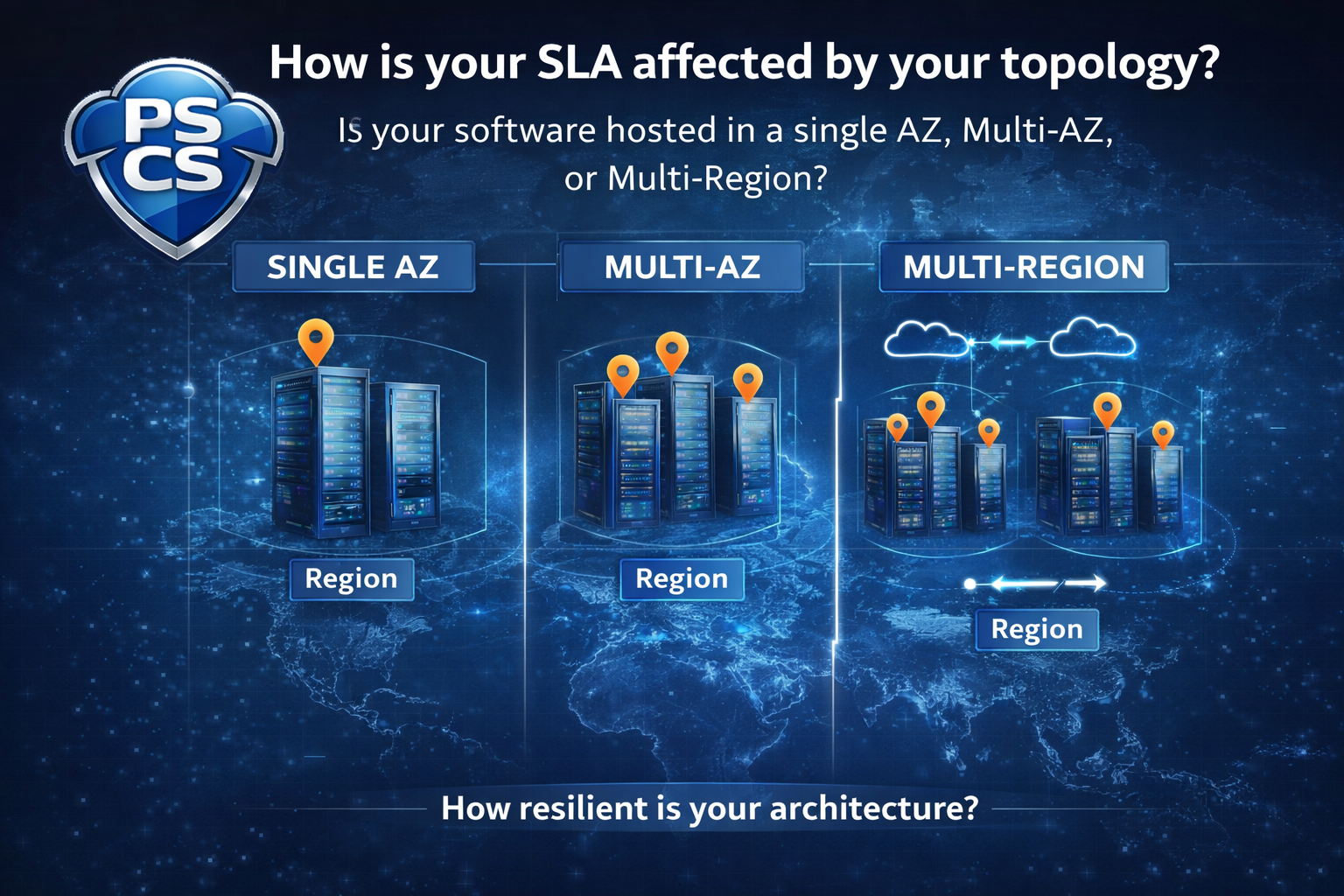
How is your SLA affected by your topology? Is your software hosted in a single AZ, Multi-AZ, or Multi-Region?
Some cloud conversations use “Region” and “Availability Zone” like they are interchangeable.
They are not. And that distinction matters the minute uptime, failover, and SLA language show up in an RFP or architecture review.
In AWS, a Region is a separate geographic area.
Within that Region are multiple Availability Zones, which are isolated locations designed to provide fault isolation inside the Region.
Azure is similar in concept. Different platform, similar idea: broad geography at the Region level, fault-isolated deployment options within it.
A Simple Way to Explain the Difference
A Region is the broad geography where your workload lives.
An AZ is the fault-isolated location inside that geography where your workload actually runs.
Using EC2 as an example, this is where the conversation starts getting more important.
A single instance in a single AZ does not carry the same resilience profile as a workload designed across multiple AZs. And a Multi-AZ design is not the same as a multi-Region continuity strategy.
The Real Question
That leads to the real question:
How is your SLA affected by your topology? Is your software hosted in a single AZ, Multi-AZ, or Multi-Region?
That question sounds simple, but it exposes a lot.
Because many organizations say they are “in the cloud,” but that alone does not tell you much about availability. It does not tell you the failure boundary. It does not tell you the recovery design. And it does not tell you what level of uptime the architecture is actually positioned to support.
Cloud Does Not Answer the Availability Question by Itself
With EC2, AWS makes these distinctions visible in the SLA language. But EC2 is only one example. There are many AWS services, and SLAs vary by service and by architecture pattern.
So when someone says a system is cloud-based, the next question should be whether it is built for single AZ, Multi-AZ, or multi-Region operation.
Because topology is not just a technical detail.
It is one of the clearest indicators of how seriously uptime, failover, and operational resilience were designed from the start.
How do you usually explain topology and SLA impact to non-technical stakeholders?
Watch and Read More
This topic is also available as a short video and LinkedIn post for teams discussing topology, uptime expectations, and cloud resiliency.