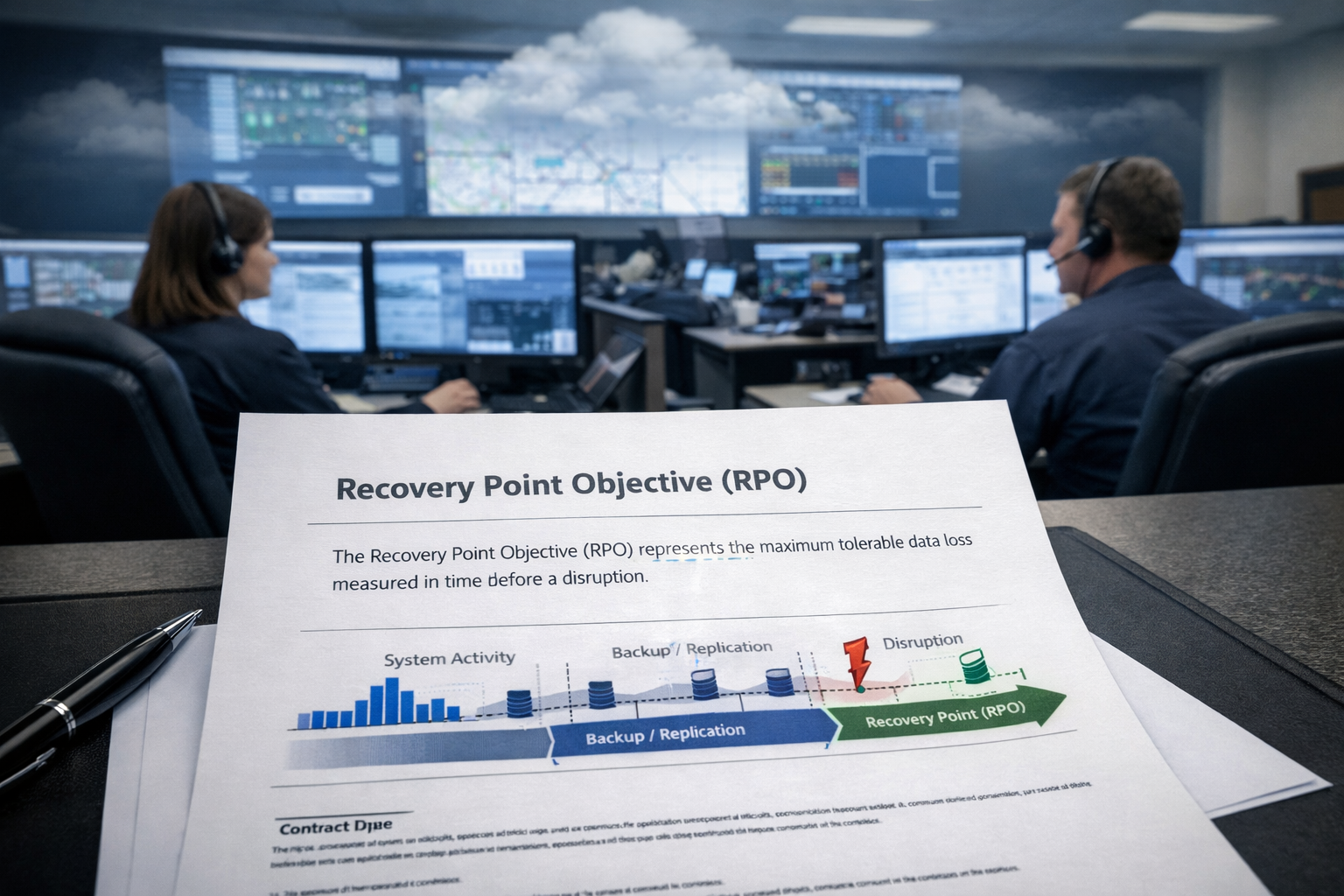
RPO is often discussed alongside RTO, but it answers a very different question.
RTO is about how long recovery takes.
RPO is about how much data loss the organization is prepared to tolerate.
That distinction matters more than many teams realize.
What RPO Actually Means
Recovery Point Objective defines the point in time you need to recover to after a disruption. In practical terms, it reflects how much information could be lost between the last recoverable copy and the moment of failure.
Simple concept.
But one that can create real misunderstanding if it is not clearly defined.
Many organizations hear terms like backup frequency, replication, snapshots, or failover and assume that means little to no data loss. Sometimes that is true. Sometimes it is not. The actual RPO may depend on architecture, replication timing, system dependencies, and the conditions required for recovery.
Where RPO Is Documented Matters
It is also important to understand where RPO is documented.
Like RTO, it may not always appear as a clear, enforceable SLA commitment. It may live in technical documentation, disaster recovery language, or supporting contract materials. That means agencies should confirm whether RPO is an operational design target, a contractual obligation, or simply a planning assumption.
The Number Itself Deserves Attention
A 15-minute RPO and a 4-hour RPO represent very different operational realities. For public safety environments, that difference can affect incident records, call information, CAD activity, reporting continuity, and confidence during recovery.
Before moving forward, agencies should ask a few plain questions: What is the actual RPO? Under what conditions does it apply? Is it based on continuous replication, scheduled backup, or something else? Are all critical systems included? And does the stated data loss tolerance align with operational expectations?
The Real Question During a Disruption
Because when disruption happens, the real question is not only how fast you come back.
It is how much you come back with.
A Final Question for Agencies
How is your organization validating that its RPO matches the reality of its operations?