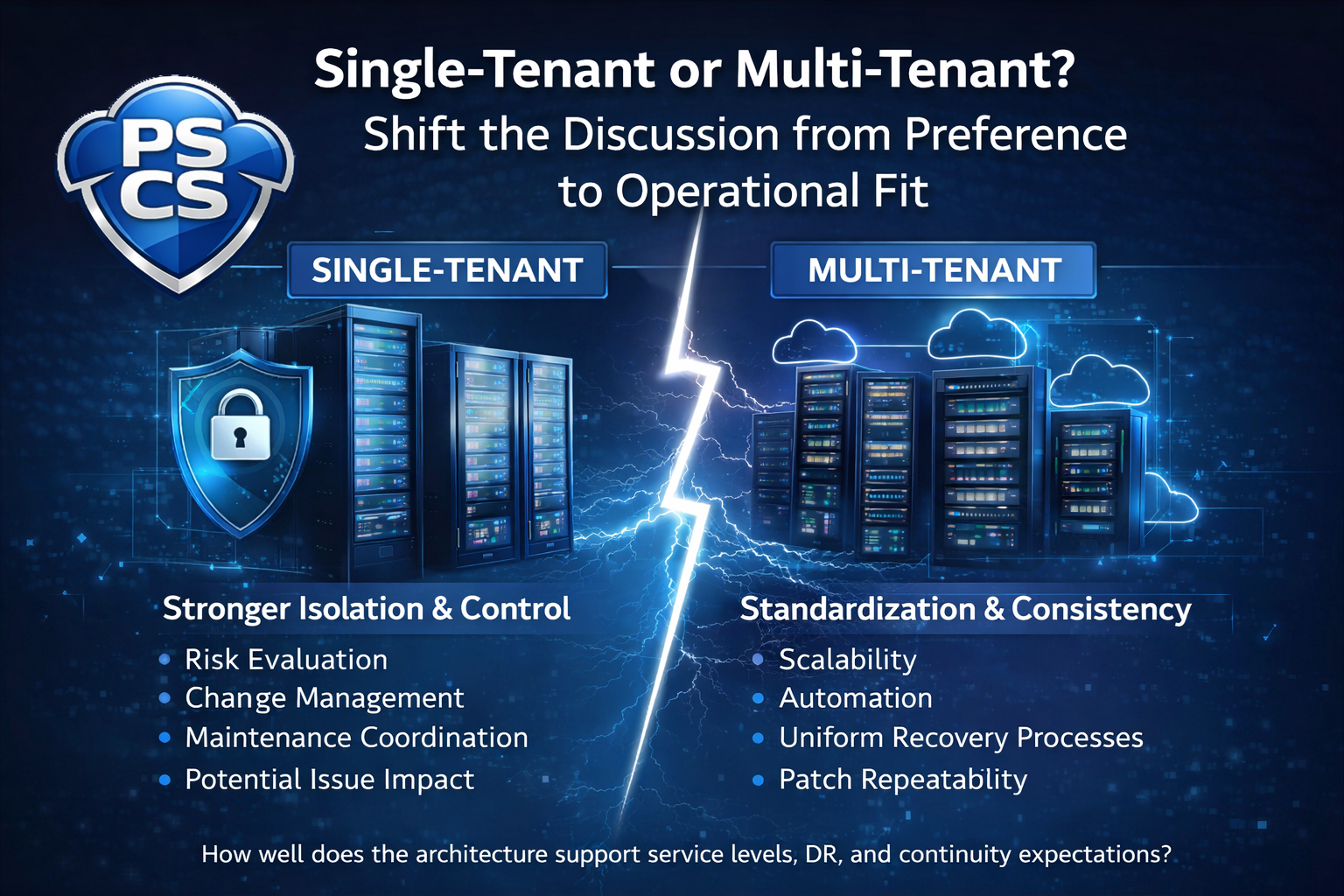
There is a lot of discussion in public safety technology about single-tenant vs. multi-tenant environments.
Most of that discussion gets framed around preference.
I think the better framing is operational fit.
From a customer perspective, the real question is not which model sounds better in a sales conversation. The real question is: how does the architecture support your service levels, disaster recovery expectations, and continuity requirements when operations are under stress?
Single-Tenant Environments
Single-tenant environments can offer customers a stronger sense of isolation and control. That can matter when you are evaluating risk, change management, maintenance coordination, or the potential blast radius of an issue.
In many cases, single-tenant designs may also make it easier to understand how your specific environment is protected, how failover is designed, and how recovery priorities are applied to your system.
Multi-Tenant Environments
At the same time, multi-tenant environments can create advantages through standardization, scale, and operational consistency. A well-run multi-tenant platform may benefit from more mature automation, more repeatable patching, and more uniform recovery processes across the customer base.
That said, neither model should be treated as automatically stronger for SLA, DR, RPO, or RTO.
Go Deeper Than the Label
The customer-side responsibility is to go deeper than the label.
For SLAs, ask how uptime is actually measured, what is included or excluded, and whether the service model changes how incidents are prioritized or resolved.
For disaster recovery, ask whether recovery is documented or demonstrated. A DR strategy is only meaningful if it has been tested under realistic conditions and the customer can understand what success looks like.
For RPO and RTO, ask for specifics. How much data loss is acceptable? How quickly can service actually be restored? Are those targets consistent across all customers, or do they vary based on architecture, contract structure, or recovery design?
Single-tenant may offer clearer customer-specific boundaries. Multi-tenant may offer stronger operational scale. Both can be effective. Both can also fall short if expectations are vague and validation is weak.
The Real Conversation
Customers should not be choosing between “good” and “bad.” They should be evaluating whether the design, the operating model, and the recovery commitments are aligned to the mission they are responsible for supporting.
That is where the real conversation should be.
How is your organization evaluating tenancy models today: by architecture labels, or by measurable recovery and service outcomes?
Watch and Read More
This topic is also available as a short video and LinkedIn post for teams evaluating tenancy models in public safety cloud environments.