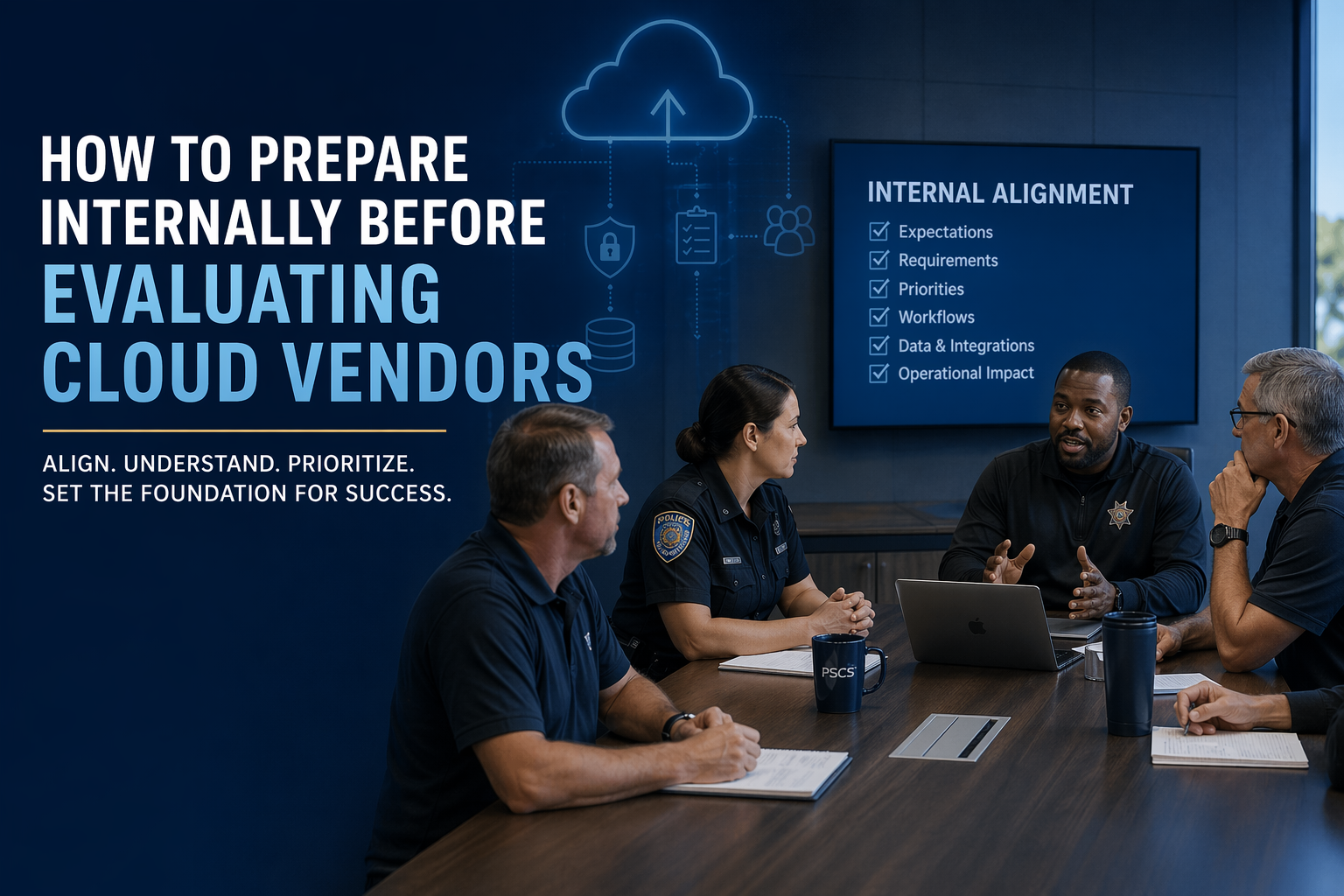
As more public safety agencies consider a transition to cloud-hosted environments, the focus often turns quickly to vendor demonstrations, feature comparisons, and pricing discussions.
Those steps matter, but the most important preparation often happens before the vendor evaluation begins.
Before evaluating cloud vendors, agencies should start internally.
Start With Internal Alignment
Different teams naturally view a cloud transition through different lenses. Leadership may be focused on risk, cost, long-term strategy, and public accountability. IT may be focused on architecture, connectivity, supportability, security, and performance. Dispatch and operations may be focused on usability, reliability, workflow impact, and what happens during an outage.
All of those perspectives are valid.
The goal is not to make every group think the same way. The goal is to bring those perspectives together before vendor conversations begin, so the agency can evaluate cloud options with a shared understanding of what matters most.
Define Expectations Before Evaluating Solutions
Before comparing vendors, agencies should align around their own expectations, requirements, and priorities.
What does success look like for the agency in the cloud? What level of uptime is expected? How much planned downtime is acceptable? What support response is needed during critical operational periods? What should recovery look like during a major outage?
These are not just technical questions. They are operational questions that affect leadership, IT, dispatch, field responders, and the community being served.
When those expectations are not clearly understood internally, vendor responses can be interpreted differently by different stakeholders. One group may hear a response as acceptable, while another may hear operational risk.
Internal alignment helps reduce that confusion before it starts.
Every Agency Is Unique
There is no single standard public safety environment.
Every agency uses its systems differently. Every agency has different workflows, integrations, data needs, staffing models, local network conditions, operational pressures, and expectations from leadership and users.
Even agencies using the same vendor can have very different cloud readiness needs based on how their environment is configured and how their people rely on the system day to day.
That uniqueness should shape the evaluation process.
Agencies should take time to understand how they use their software, how data moves through the environment, which integrations are mission-critical, what workflows cannot be interrupted, and what local responsibilities remain with the agency after the move to the cloud.
Use the Agency Assessment Mindset
This is where an agency assessment mindset becomes valuable.
The purpose is not just to create a list of questions for a vendor. The purpose is to help the agency understand itself more clearly before it begins evaluating outside solutions.
That includes documenting expectations around uptime, support, maintenance, recovery, data access, data retention, integrations, connectivity, testing, escalation, and shared responsibility.
It also means identifying where internal stakeholders may have different assumptions. Those differences are much easier to resolve before procurement than after contract signature or go-live.
Internal Clarity Improves Vendor Conversations
When an agency is aligned internally, vendor conversations become more productive.
Instead of asking generic cloud questions, the agency can ask questions tied directly to its operational needs. How does the vendor define downtime? What is included or excluded from the SLA? How are maintenance windows handled? How is RTO defined, and when does the recovery clock actually start? How are integrations included in recovery planning? What visibility will the agency have during an incident?
These questions create stronger conversations because they are grounded in the agency’s actual environment, not just a general cloud checklist.
Alignment Before Evaluation Changes Outcomes
Cloud transitions are not only technology decisions. They are operational decisions that affect how public safety services are delivered every day.
When agencies prepare internally first, vendor evaluations become clearer, requirements become stronger, priorities become easier to defend, and expectations are less likely to become a source of friction later.
The goal is not simply to select a vendor.
The goal is to make sure the selected solution aligns with how the agency operates, what the agency expects, and what the agency actually needs.
That alignment starts internally.
How PSCS Can Help
Public Safety Cloud Standards helps agencies create clarity and alignment before engaging vendors, so expectations, priorities, requirements, workflows, and operational needs are defined before contracts are signed.
Continue the Conversation →More from Public Safety Cloud Standards
24x7 Accountability in Public Safety Cloud Systems
Why resilience cannot take a day off in public safety environments.
Read Article →Observability in Public Safety Cloud Systems
What agencies should expect when something goes wrong.
Read Article →Data Ownership and Control
Why agency ownership needs to translate into real operational control.
Read Article →Data Access Governance
Who can reach public safety data, when, and with what accountability.
Read Article →