From Defining What You Need to Assuring What You Get
Cloud migration remains a major area of focus for PSCS. A successful public safety cloud migration requires more than selecting a vendor and signing a contract. The PSCS Cloud Migration Assurance Workflow provides an independent, seven-stage process to define agency requirements, validate vendor capabilities and commitments, carry those requirements through implementation and testing, and continue verifying performance after go-live.
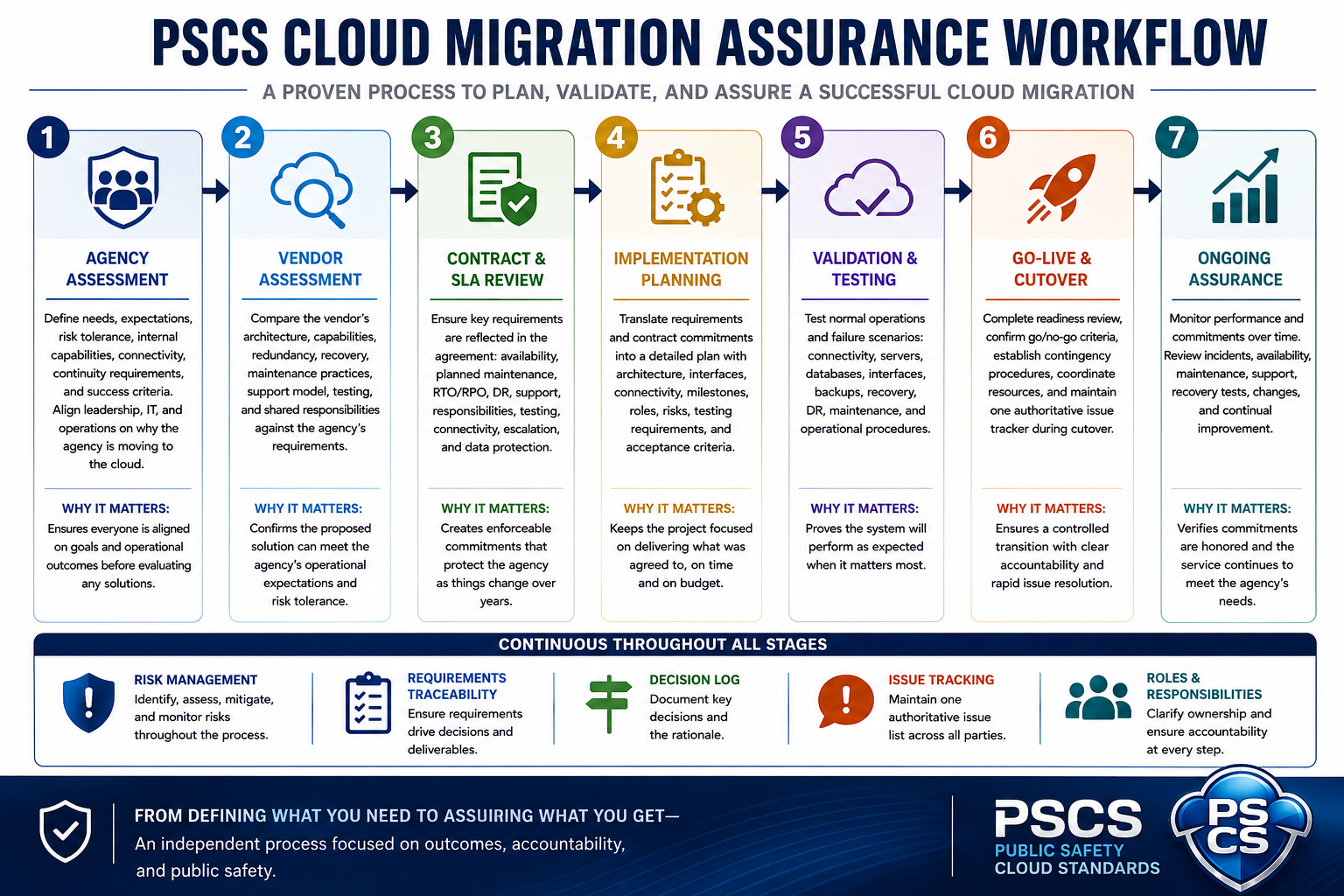
Agency Assessment
Define needs, expectations, risk tolerance, internal capabilities, connectivity, continuity requirements, and success criteria.
Vendor Assessment
Compare the vendor's architecture, capabilities, redundancy, recovery, maintenance, support, testing, and shared responsibilities against agency requirements.
Contract & SLA Review
Ensure availability, maintenance, RTO/RPO, disaster recovery, support, testing, connectivity, escalation, responsibilities, and data protection are reflected in the agreement.
Implementation Planning
Translate requirements and contractual commitments into a detailed plan with architecture, interfaces, milestones, roles, risks, testing requirements, and acceptance criteria.
Validation & Testing
Test normal operations and failure scenarios across connectivity, servers, databases, interfaces, backups, recovery, DR, maintenance, and operational procedures.
Go-Live & Cutover
Complete readiness review, confirm go/no-go criteria, establish contingency procedures, coordinate resources, and maintain one authoritative issue tracker.
Ongoing Assurance
Monitor performance and commitments over time, including incidents, availability, maintenance, support, recovery tests, changes, and continual improvement.
Mission Statement
Public Safety Cloud Standards exists to improve the resiliency, transparency, and accountability of mission-critical public safety technology.
We support agencies through independent technical guidance, assessments, vendor and architecture reviews, cloud transitions, contract review, and operational resiliency planning — while advancing measurable standards that help agencies better understand what they should expect from the technology and services they depend on.
Advancing a Higher Operational Standard
Public Safety Cloud Standards advocates for measurable, transparent criteria that agencies and vendors can align around — across on-premises, cloud, and hybrid environments.
We focus first on Computer-Aided Dispatch (CAD) and other mission-critical public safety systems, while maintaining cross-platform insight across the ecosystem. The goal is not to favor one deployment model, but to help agencies understand whether the technology they depend on is designed, operated, and supported in a way that meets the mission.
Availability is only one part of that picture. Operational resiliency also considers what happens when infrastructure fails, connectivity is lost, maintenance occurs, recovery is required, or responsibilities are unclear. Our framework evaluates indicators of operational maturity, including:
Uptime transparency
Clear definitions, consistent measurement, and shared visibility into performance.
SLA structure and clarity
Availability language that is understandable, actionable, and aligned to mission needs.
RPO/RTO validation
Recovery objectives supported by documented testing practices and measurable outcomes.
Disaster recovery discipline
Planned exercises, outcomes reporting, and continuous improvement over time.
Monitoring maturity
Detection, alerting, and incident response practices that support 24/7 operations.
Network resilience
Connectivity assumptions made explicit, reviewed, and validated where possible.
Shared responsibility mapping
Clear delineation of roles across vendor and agency operational responsibilities.
Architecture clarity
Documented design patterns and transparent operational constraints.
How PSCS Can Help
PSCS is not limited to one deployment model or one stage of a technology project. We provide independent guidance where agencies need additional technical depth, operational perspective, or vendor accountability.
Operational Resiliency & Architecture
Review on-premises, cloud, and hybrid environments for dependencies, failure points, redundancy, connectivity, recovery concerns, and opportunities to strengthen resilience.
Cloud Migration Assurance
Guide agencies from requirements and vendor evaluation through contracting, implementation, testing, go-live, and ongoing assurance using the PSCS seven-stage workflow.
Vendor & Technology Evaluation
Independently evaluate architecture, technical claims, service models, availability, recovery capabilities, maintenance practices, testing, support, and shared responsibilities.
Contract & SLA Review
Help ensure important technical and operational expectations are reflected in agreements around availability, RTO/RPO, disaster recovery, maintenance, support, testing, escalation, and accountability.
Disaster Recovery & Continuity
Assess whether recovery architecture, technical capabilities, operational procedures, connectivity, and testing practices support the agency's actual continuity needs.
Independent Technical Advisory
Provide experienced, vendor-neutral guidance when leadership, IT, operations, procurement, or vendors need help working through complex technology decisions, implementations, outages, or operational issues.
Standards & Framework Development
Develop measurable criteria and repeatable frameworks intended to improve resiliency, transparency, and accountability across public safety technology.
Strengthen the Technology Your Agency Depends On
Whether you are evaluating an existing environment, preparing for a cloud migration, reviewing a vendor or contract, or working through a resiliency concern, PSCS can provide an independent technical perspective focused on operational outcomes.